100 Pisama/100 Letters, 2008 - Marina Abramovic
About the Work
About 100 Pisama/100 Letters
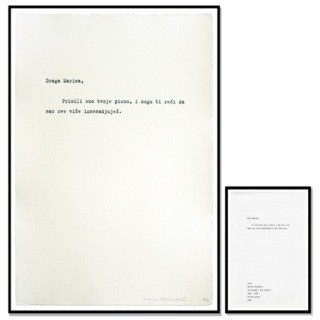
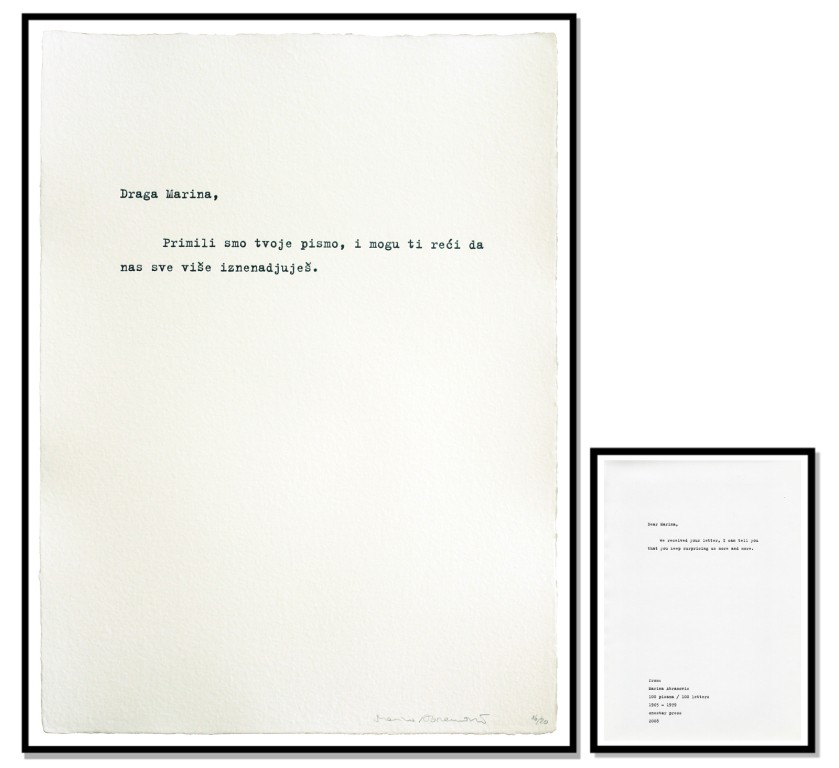
This work is a letterpress edition with an extract from the artist's book 100 Pisama, 100 Letters, which collected the first sentence of every letter the artist received between 1965 and 1979. The print is accompanied by an English ...Read More
This work is a letterpress edition with an extract from the artist's book 100 Pisama, 100 Letters, which collected the first sentence of every letter the artist received between 1965 and 1979. The print is accompanied by an English translation of the Serbian original, reading: "Dear Marina, We received your letter, I can tell you that you keep surprising us more and more."
Read Less
Read Less
About the Artist
About Marina Abramovic
Since her 2010 retrospective at the Museum of Modern Art in New York—the largest exhibition dedicated to performance in the institution's history—Belgrade-born ...Read More
Since her 2010 retrospective at the Museum of Modern Art in New York—the largest exhibition dedicated to performance in the institution's history—Belgrade-born, New York-based artist Marina Abramovic's name has become virtually synonymous with performance art. Centering on explorations of the body in extreme situations and the relationship between performer and audience, Abramovic's charged performances often incorporate elements of ritual or myth, exploring the spiritual or transcendental possibilities of physical and mental stress.
In what is perhaps her best-known early work, Rhythm 0 (1974), the artist sat passively in front of a table with an assortment of 72 objects—ranging from a rose and a feather to a scalpel and a loaded gun—that the audience was invited to use on her in any way they wished. Over the course of the performance, the audience became increasingly aggressive in their actions; while they were initially cautious and tentative, her complete lack of reaction to their gestures encouraged some to act more forcefully—one audience member famously pointed the gun at her head. Placing control over both the performance and her own safety into the hands of strangers, Abramovic tested the audience's limits, seeing how far they were willing to go in the absence of restrictions.
After leaving Serbia in the late 1970s, Abramovic began a decade-long collaboration and love affair with the West German artist Ulay, resulting in performances such as Imponderabilia (1977), in which the two artists stood opposite one another in a doorway, each completely nude; in order to pass, audience members were forced to squeeze between them sideways, having to choose which of the artists to face as a result. Their collaboration concluded in 1988 with The Great Wall Walk, in which Abramovic and Ulay each walked the length of the Great Wall of China, starting at opposite ends and meeting in the middle, where they formally ended their creative and romantic partnership.
More recently, Abramovic has been increasingly concerned with the issues surrounding the preservation of performance art. In 2005, she presented Seven Easy Pieces at the Guggenheim Museum in New York, in which she recreated five seminal works of performance from the 1960s and '70s, including Vito Acconci's Seedbed (1972) and Gina Pane's The Conditioning (1973), along with two works of her own. For her 2010 career retrospective at MoMA—for which she sat silently in the museum's atrium for the entire run of the exhibition, inviting visitors to sit opposite her—her performances were represented not only by photographic and video documentation but also by "re-performances," with live actors recreating many of her past works in the galleries. Additionally, Abramovic plans to pass on her artistic legacy to younger generations through a nonprofit organization dedicated to the preservation of performance art, located in Hudson, New York.
In 1997, Abramovic won the Golden Lion at the Venice Biennale for her installation and performance Balkan Baroque, for which she cleaned a pile of cow bones, reflecting on the tumultuous history of the Balkan states, and in particular her native Yugoslavia, which had collapsed in the midst of civil wars in the early 1990s. The subject of numerous international exhibitions, Abramovic was included in Documenta VI (1977), VII (1982), and IX (1992), and in the 2004 Whitney Biennial. Read Less
In what is perhaps her best-known early work, Rhythm 0 (1974), the artist sat passively in front of a table with an assortment of 72 objects—ranging from a rose and a feather to a scalpel and a loaded gun—that the audience was invited to use on her in any way they wished. Over the course of the performance, the audience became increasingly aggressive in their actions; while they were initially cautious and tentative, her complete lack of reaction to their gestures encouraged some to act more forcefully—one audience member famously pointed the gun at her head. Placing control over both the performance and her own safety into the hands of strangers, Abramovic tested the audience's limits, seeing how far they were willing to go in the absence of restrictions.
After leaving Serbia in the late 1970s, Abramovic began a decade-long collaboration and love affair with the West German artist Ulay, resulting in performances such as Imponderabilia (1977), in which the two artists stood opposite one another in a doorway, each completely nude; in order to pass, audience members were forced to squeeze between them sideways, having to choose which of the artists to face as a result. Their collaboration concluded in 1988 with The Great Wall Walk, in which Abramovic and Ulay each walked the length of the Great Wall of China, starting at opposite ends and meeting in the middle, where they formally ended their creative and romantic partnership.
More recently, Abramovic has been increasingly concerned with the issues surrounding the preservation of performance art. In 2005, she presented Seven Easy Pieces at the Guggenheim Museum in New York, in which she recreated five seminal works of performance from the 1960s and '70s, including Vito Acconci's Seedbed (1972) and Gina Pane's The Conditioning (1973), along with two works of her own. For her 2010 career retrospective at MoMA—for which she sat silently in the museum's atrium for the entire run of the exhibition, inviting visitors to sit opposite her—her performances were represented not only by photographic and video documentation but also by "re-performances," with live actors recreating many of her past works in the galleries. Additionally, Abramovic plans to pass on her artistic legacy to younger generations through a nonprofit organization dedicated to the preservation of performance art, located in Hudson, New York.
In 1997, Abramovic won the Golden Lion at the Venice Biennale for her installation and performance Balkan Baroque, for which she cleaned a pile of cow bones, reflecting on the tumultuous history of the Balkan states, and in particular her native Yugoslavia, which had collapsed in the midst of civil wars in the early 1990s. The subject of numerous international exhibitions, Abramovic was included in Documenta VI (1977), VII (1982), and IX (1992), and in the 2004 Whitney Biennial. Read Less
Description
Two prints, one measuring 19.69" x 29.92" with a phrase printed with a letterpress on Mouldmade Eskulan paper, and one measuring 8.27" x 11.69" laser printed on Munken paperAuthentication
Signed and numbered by the artist on recto.Shipping
Ships in 10-14 business days.This work is final sale and not eligible for return.
ARTSPACE ADVISOR
We are here to help. Please let us know if you have any questions about this work, the artist, collecting in general or artists you'd like to see on Artspace. Please call us at (212) 675-5804 or email chairman@artspace.com and we'll respond within 24 hours.