

About The Work
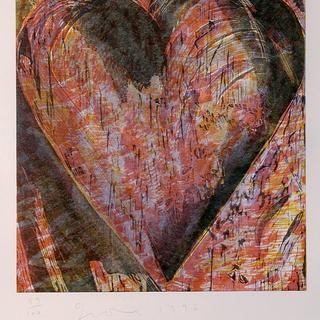
This woodcut employs Dine's most recognizable motif, the heart, which has recurred throughout his work for the past several decades. As the artist noted in a 2010 interview, "I use it as a template for all my emotions. It's a landscape for everything. It's like Indian classical music—based on something very simple but building to a complicated structure. Within that you can do anything in the world. And that's how I feel about my hearts."
About Jim Dine
From The Magazine
- Interviews & Features: IFPDA Print Fair Preview - An Interview with Tandem Press
- Art 101: From Flamethrowers to Acid Attacks, 8 Ways Artists Have Waged War on Canvas
- Art 101: 10 of the Most Influential MFA Programs in the World
- Contributors: The Many Faces of the 2014 Whitney Biennial
- News & Events: A Heroic German Art Dealer Gets His Due, Scenes From Galleries Across the City, & More
6-color woodcut on Arches heavy weight buff paper
18.75 x 17.25
Signed and numbered on recto.

About The Work
This woodcut employs Dine's most recognizable motif, the heart, which has recurred throughout his work for the past several decades. As the artist noted in a 2010 interview, "I use it as a template for all my emotions. It's a landscape for everything. It's like Indian classical music—based on something very simple but building to a complicated structure. Within that you can do anything in the world. And that's how I feel about my hearts."
About Jim Dine
From The Magazine
- Interviews & Features: IFPDA Print Fair Preview - An Interview with Tandem Press
- Art 101: From Flamethrowers to Acid Attacks, 8 Ways Artists Have Waged War on Canvas
- Art 101: 10 of the Most Influential MFA Programs in the World
- Contributors: The Many Faces of the 2014 Whitney Biennial
- News & Events: A Heroic German Art Dealer Gets His Due, Scenes From Galleries Across the City, & More
- The quoted dimensions are for the paper size. The image size is 18.75" x 17.25".
- Ships in 3 to 5 business days from New York. Framed works ship in 7 to 9 business days from New York.
- This work is final sale and not eligible for return.
- Questions about this work?
- Interested in other works by this artist or other artists? We will source them for you.
- Want to pay in installments?
Contact an Artspace Advisor
advisor@artspace.com